A Tale of Bigamy and Transportation
One of the most interesting stories from my family history has come from this chap, my 4th great uncle. Christened at Eastwood, Nottinghamshire, on 19th January 1800, the son of William Levers and Ann Saxton, he led a notorious life.
A coal miner, he married Mary Morrell in 1821 at Selston, Nottinghamshire and they had 5 children.
Unfortunately, for whatever reason, Vincent left the family home and Mary brought the children up. Vincent moved to North Wingfield in Derbyshire and then attempted to marry again. At least twice the banns were read but marriages never actually took place. Perhaps the vicar or the intended spouses found out Vincent’s secret that he was already married.
Vincent then moved up to Yorkshire and this time, in 1834, went through a bigamous marriage, under the very imaginative pseudonym of John Smith!
Ten years later in 1844 Vincent went through yet another bigamous marriage, this time at Hetton Le Hole in Durham.
The law eventually caught up with Vincent and he was brought firstly before magistrates at Wakefield in June 1845.
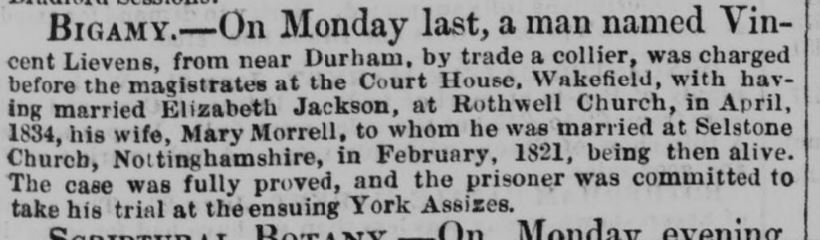
The following month he appeared before York Assizes at York Castle.
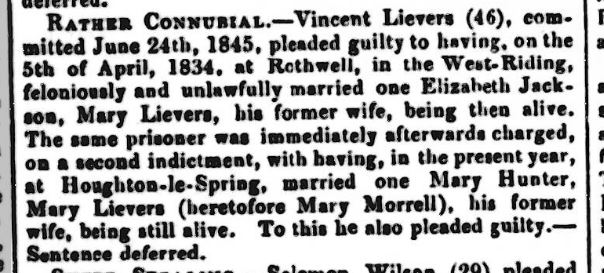
Convicted of two counts of bigamy, he was sentenced to six months hard labour for the first offence and seven years transportation for the second.
The records of prisoners state that Vincent’s next of kin was the bigamous wife he left in Hetton le Hole, Mary Levers.
Did she know Vincent’s secret when she married him?
Vincent must have had some attractions since at least five women had agreed to marry him. His legal first wife, Mary, the mother of his children. Then two women in North Wingfield where the banns were read but no marriages ever took place. Then the lady in Yorkshire and the last one in Durham. Perhaps he was a handsome charmer. He certainly was not rich since he was a coal miner throughout his life.
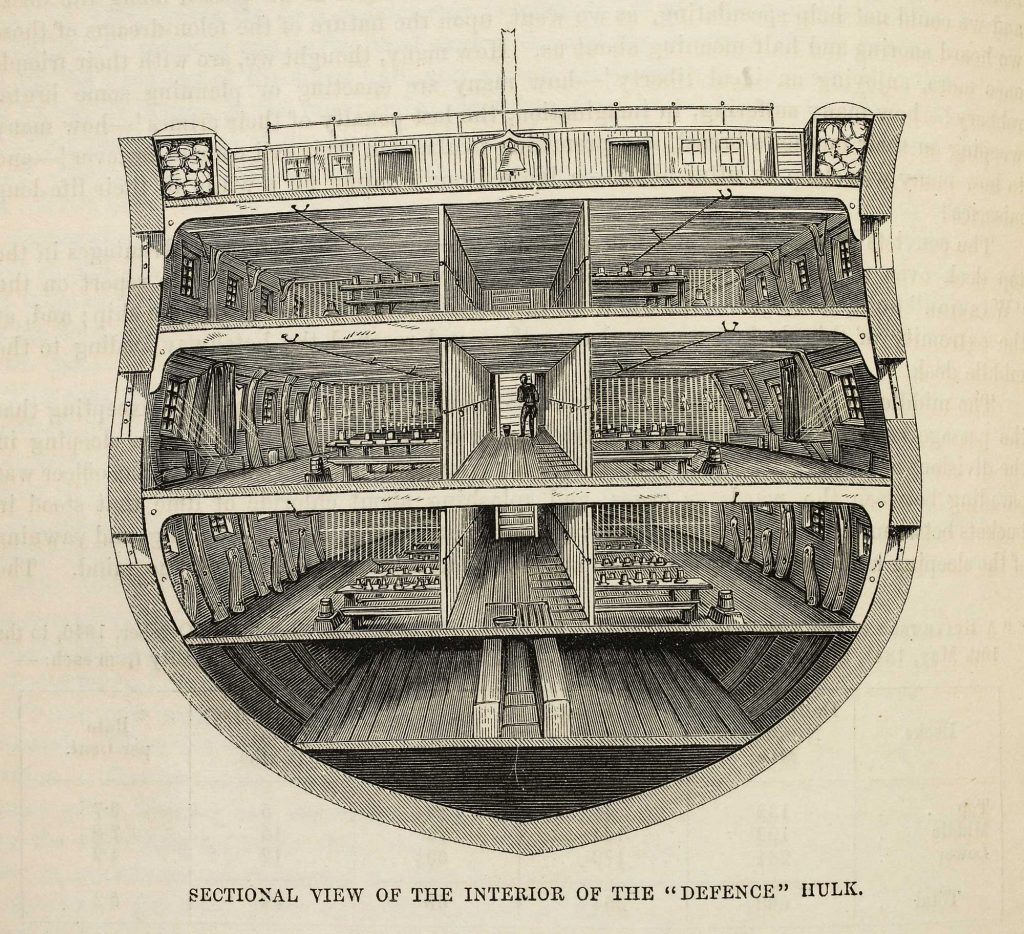
After being sentenced, Vincent was held aboard a hulk and eventually transported to Bermuda.
From 1824 to 1863, Britain shipped around 10,000 convicts to Bermuda to work on building the Dockyard’s fortifications. They were incarcerated in the nine prison ships also called hulks, which were permanently docked off Ireland Island off Bermuda.
These hulks were decommissioned Royal Navy ships which had their masts removed and extra decking and roofs added and used as floating jails.
The conditions the convicts endured in Bermuda were horrific. The hulks where they slept were crowded and disease ridden. The hard labouring jobs were back breaking and the heat unbearable.
Vincent is mentioned in the Royal Naval Medical Journals in 1846 in Bermuda. He was suffering from cholera and almost died. The description of his condition was graphic and eventually Vincent was shipped back to England, presumably to serve out his sentence.
He eventually returned to Nottinghamshire and entered Nottingham Workhouse where he died in 1861. Vincent Saxton Levers was buried at St Marys Nottingham, 27 November 1861 aged 72.
Vincent’s Legacy
Vincent’s wife Mary brought up their five children. Daughter Mary died young and a son, William has yet to be traced. However, daughters Sarah and Rebecca and Ann all married and produced 10 grandchildren between them.
Sarah married a policeman (I wonder if he knew of Sarah’s errant father?) and some of her six children led interesting lives. Daughter Rebecca Levers Ball married a successful businessman and Rebecca’s son, carried on the family firm, and became a well respected Mayor of Rotherham. A far cry from his great grandfather’s life of penal servitude and lowly death in the workhouse.
___________________________________________________________________________________________
Information
The above newspaper articles are from the British Newspaper Archive
https://www.britishnewspaperarchive.co.uk/
The Royal Naval Medical Journals are on Ancestry.co.uk https://www.ancestry.co.uk/
The following website gives details of the life of those prisoners onboard the hulks https://staffblogs.le.ac.uk/carchipelago/2017/10/10/a-day-in-the-life-convicts-on-board-prison-hulks/
